The 3-Level Framework For Turning Negative Feedback Into The Right Fix For Your Course
So every round of feedback leaves the course stronger

I had a pet rat as a kid. I stepped on it one day.
My sister had let it run around the garage but I didn’t know. I was walking barefoot when I felt my foot landing on something white, warm and fuzzy. My rat.
And what happened to the poor creature?
I could only imagine having to tell my parents that I killed my special pet. Even if my sister shouldn’t have let it out without telling me. It would be my foot that ended it’s life.
As my arch felt fur, I had an immediate reaction. My knee shot straight up into my chest. Then I picked up my rat to check it out. Was it OK? Did I squish it? After a few minutes the verdict was in. My pet was unharmed.
It was only due to a literal knee-jerk response that my rat was saved.
Instincts keep you alive right now, no time to think. Knee up. Hand off the stove.
But a blunt email from a customer isn’t a threat, even if it feels like one. A quick reflex saved my rat. But an unthinking response can wreck your course.
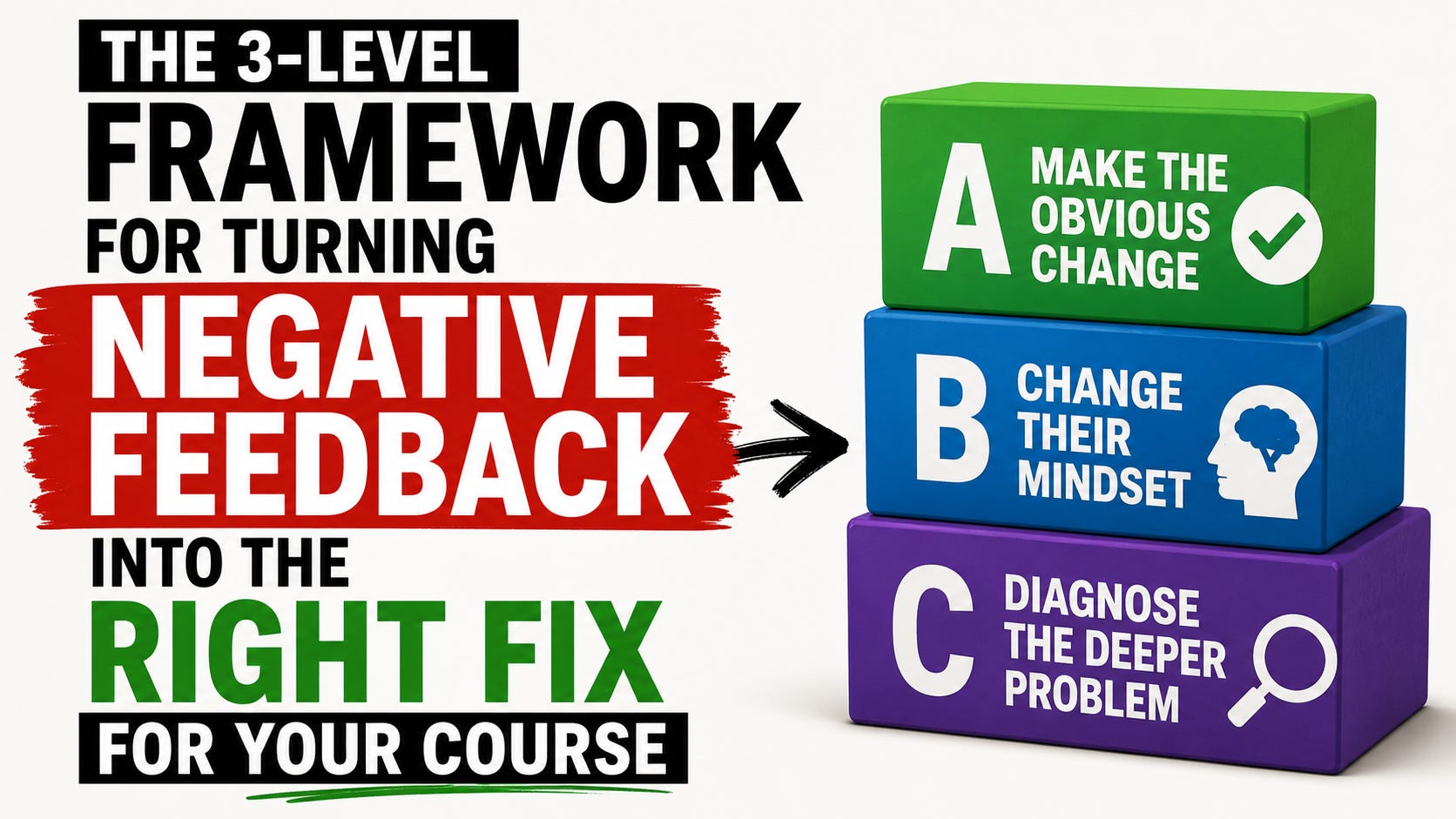
So instead of reacting, we diagnose the issue. That’s why we’ll discuss three ways to respond to customer feedback on your course.
They are:
A. Make the obvious change
B. Change their mindset
C. Diagnose the deeper problem
Let’s begin.
A. Make the obvious change
This is the one time the reflex is actually the right move.
Summary notes, visuals, a live demonstration: whatever’s easy and obviously useful, just build it.
Some suggestions are just obviously good. If it’s easy to implement and it makes the course better, you make it. No mindset shift required, no deeper diagnosis needed. You just do the obvious thing.
I wish more of course-building was this simple. It’s not. Which is why the next two need something slower than a knee-jerk reaction.
B. Change their mindset
Sometimes the student has the wrong idea.
In our most recent course at the Lefkoe Institute, we got consistent feedback asking for more buddy assignments.
We’d previously reduced them on purpose, because in past cohorts, students couldn’t keep up when there was more than one buddy assignment a week. And here’s the kicker: the SAME students asking for more buddy work were also telling us how hard it was to keep up with the existing workload.
So what do we do? On one hand, we know more buddy work led to fewer students completing the course due to overwhelm. On the other hand, the students are asking because they feel they need it.
Taking some time helped me see what to do. Address the belief underneath the request.
Their belief “All the buddy practice should happen during the course.”
In the next iteration of the course, we’re teaching students WHY there’s a limited number of buddy assignments, but also making it easy for them to keep working with each other after the course ends. Same underlying want. Different, better way to meet it.
C. Diagnose the deeper problem
Sometimes customers are suggesting the wrong solution to a real problem.
In my latest course for the Lefkoe Institute, students asked us to organize every tip given by every instructor to every student. Sounds fair, right? Except in our last course there were nearly 21,000 messages. That’s an overwhelming amount of information. Sure, I could use AI to make it all searchable and accessible in about an afternoon.
But I also know that doing so would actively hurt them.
These students are learning to coach other people. And when you’re sitting across from a client, you can’t be rifling through notes or running a search — you have to be listening, then responding at a natural, human speed. That means knowing what to say intuitively, or at worst with a short pause to think. Most students get there by the end of the course.
A few still feel shaky on one or two specific skills.
What actually helps THAT problem is picking the one skill that feels shaky, building a plan to improve just that one, pulling only the material that supports it, and then, once it’s solid, moving to the next skill.
These students believed they needed ALL the information to succeed.
They hadn’t yet realized that the step-by-step approach that got them through the course is the same approach they need for the rest of their careers. Focused practice on one skill at a time. Information wasn’t going to get them to intuitive performance. Only practice was.
That’s a design fix. We hadn’t taught them how to keep learning after the course ends.
You have more than one option, every time feedback comes in
So next time a student complaint lands in your inbox, consider these three moves:
A. Surface - If it’s an easy and obvious change. Make it.
B. Mindset - If the request is reasonable, but granting it would hurt them. Teach them why, and solve the underlying want a better way.
C. Design - If the feedback is a symptom, something in how you built the course needs to change.
Most people only ever check for A. The other two require you to sit with the feedback a little longer before you act on it.
My instant reaction saved my rat because there wasn’t time to think. There’s almost always time to think about a piece of course feedback. Use that time. Diagnose before you respond, and you’ll do right by your students far more often than a rapid response ever could.
If you’re building a course right now and want the structure sturdy enough to survive this kind of feedback before it ever reaches a student, that’s exactly what the Atomic Course Blueprint is built for — a focused process for building a small, tight course that doesn’t fall apart the first time someone pushes on it.
Got a piece of feedback that took you a while to figure out what to do with?
Hit reply and tell me about it, I read every one.
Great, actionable framework Rodney, thanks.
And glad you didn't accidently smoosh your rat friend.